
THE CHARACTER PREMIUM

Updated: Jul 30
Why who you are as a Leader matters more than what you know
The room at HAVAS Village on the evening of 3 June 2026 had already given us two powerful ideas — that staying still is a risk, and that AI is an amplifier rather than a replacement. But there was a third insight waiting, and it came not from the data, but from the stories. The stories of how these leaders had become who they are. And what emerged, across three very different careers, was something that no survey can fully capture and no algorithm can replicate: character.
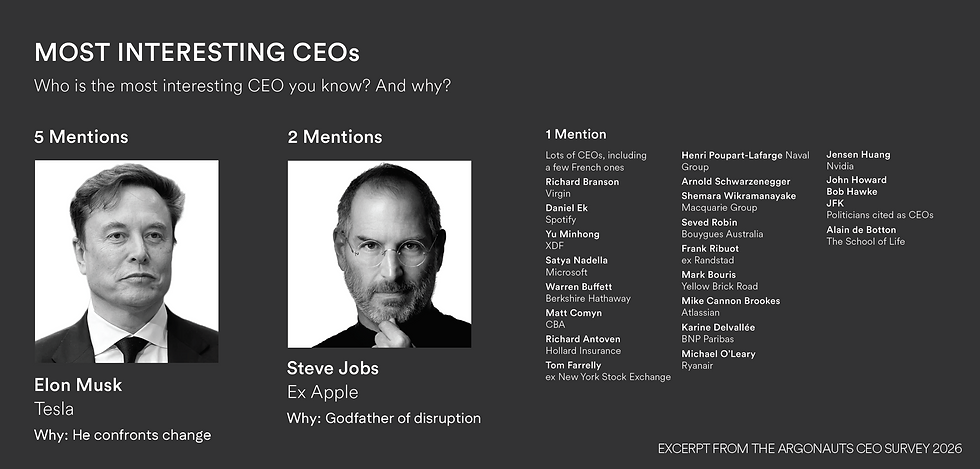
The most cited CEO in our survey: what Elon Musk reveals about Leadership
Before we arrived at character, we had to pass through the question of inspiration — and the survey produced a striking result. When we asked our 40+ CEO interviewees to name the most interesting leader they knew, one name came up more than any other: Elon Musk.
Not because every respondent admired him. Not because they agreed with his methods, his politics, or his public persona. But because, in the words of Dominique Gill, Founder and Managing Director of Urban Core: "You like him or you don't like him — you can't say yes or no — but he does inspire. And I think the best we can do, if we want people to show up, is to inspire them."

The story that kept surfacing was the SpaceX scene — Musk addressing his team, telling them that if they worked 100-hour weeks while their competitors worked 50, they would be twice as far ahead within a year. And the extraordinary part was not the demand. It was the response. Hands went up. People said yes. Because the mission — to put a human being on Mars — was larger than any individual sacrifice, larger than any job description, larger than any reasonable expectation of what an employer can ask of an employee.
"His mission at SpaceX was to take people to Mars. People showed up every day because they wanted to put a man on Mars — not because they were trying to pay their bills." — Dominique Gill, Founder and Managing Director, Urban Core

This is what character does that capability alone cannot. It generates voluntary commitment — the willingness of people to bring more than their job description asks, because they believe in something beyond the transaction. And it raises an uncomfortable question for every leader in the room: what is the mission that people in your organisation would work 100 hours a week for? Not because you're asking them to. But because they've chosen to.
Knowledge is no longer king
Dominique Gill was characteristically direct about this: "Knowledge is no longer king. Everyone has access to knowledge — it's in the palm of our hands. It's no longer what differentiates us. Judgement is important. The ability to make judgement is what is going to keep us ahead of the game."
It is a striking claim, and yet it is borne out by everything the CEO Survey 2026 revealed. The leaders who are thriving in this environment are not the ones who know the most. They are the ones who can act with confidence on incomplete information, who can read a room, who can sense when the data is pointing one way and the truth is pointing another.
Steve Vamos, who has led organisations through multiple waves of technological disruption — at Apple, IBM, Microsoft, and Xero — put it this way. The CEO, he argued, is not a chief executive officer. The CEO is a change executive officer. And the capability that matters most in that role is not domain expertise. It is the capacity to apply the right mindset to each situation — to shift from control to curiosity, from knowing to learning, from being the answer to being the question.
"Instead of controlling, it's caring, connecting, enabling. Instead of being afraid to make mistakes, it's understanding that mistakes are your journey. And instead of being the know-it-all, you have to be alert — because in a changing environment, what you used to know may not be relevant anymore." — Steve Vamos, former CEO, Xero

Steve shared his own turning point: his appointment as CEO of ninemsn, at the very dawn of the digital media age, with zero experience in advertising or media. He was, by every conventional measure, the wrong person for the job. And yet — or rather, precisely because of it — he became the right one. Because with no domain expertise to fall back on, his only option was to ask. To listen. To clear the way for the people around him. And in doing so, he discovered what he believed to be the actual work of a CEO: making others great.
"What a blessing that I had no domain expertise" — his words — captures something essential about the shift that is underway. In an era where knowledge is abundant and freely available, the premium is on the things that knowledge cannot provide: judgement, curiosity, self-awareness, and the courage to act.
What AI cannot do — and why it matters
The survey produced one of its most quoted observations not from the panel, but from Patrick William, CEO of Rixon Capital, during his one-on-one interview. Speaking from the perspective of funds management — a people business, where capital follows conviction — he put it plainly:
"There's too much nuance in underwriting. AI doesn't pick up emotions and character." — Patrick William, CEO, Rixon Capital

He was making a specific point about why his firm remains wary of over-relying on AI — because if AI could do the work, investors would simply stop paying management fees. But the observation cuts far beyond funds management. If AI cannot pick up emotions and character in the room where capital decisions are made, it cannot do so in the boardroom either. Or in the conversation where a team member is struggling but not saying so. Or in the negotiation where the other party has reservations they haven't yet voiced.
Steve Vamos offered his own version of this: "Are you going to take AI to court, or are you going to take a human to court if something goes wrong? Where is the accountability that's going to be attached to AI?" It was said lightly, but it lands heavily. AI can accelerate a decision. It cannot be held responsible for one.
The poker table: making the best decision with whatever hand you're dealt
Dominique Gill offered one of the evening's most memorable images. Studying poker players, she had found that it is not the ones dealt the best hand who consistently win. It is the ones who make the best decisions with whatever hand they have. And that, she argued, is exactly where leaders find themselves today.
"We can't know what's coming. We don't know what the future holds. AI is changing so quickly, there are wars, rules changing every day. We just have to keep making the best possible decisions with whatever's in front of us right now." — Dominique Gill, CEO, Urban Core
This is what resilience actually looks like in practice. Not the absence of uncertainty, but the capacity to act well within it. Not the best hand — the best decision. And crucially, the willingness to change your mind when the situation changes, without interpreting that change as failure.
"Changing your mind and changing your strategy doesn't make you look less competent," she said. "It's actually a display of honesty, a display of willingness to learn. You can become really respected even though you might have changed your mind a few times before making a final call." And then the line that stayed in the room: "You don't fail. You just learn. And you keep going."
Dominique Gill 2.0 — and the Mindset Coach
There was one moment in the evening that produced an unexpected ripple of recognition across the room: Dominique Gill describing her most difficult year in ten years of running Urban Core, and what it required of her.
She had never previously believed in mindset coaching. She was a builder. She operated in the physical world, with margins, contracts, risk models. What could a mindset coach offer? Then came the year that tested everything — and she found herself in national team meetings, projecting confidence and certainty while a quiet voice inside told her it was over.
"Finding the strength in me to show up — to go and have national team meetings with my entire company and tell them the future is right, when deep down I have a little voice telling me this is all over — that was all based on just finding the strength in me."
She described herself now, without a trace of irony, as “Dom Gill 2.0”. Not because the business had changed, but because she had. And the agent of that change was not a strategy consultant, not a board, not a restructuring plan. It was the inner work — the recognition that the gap between what a leader projects and what a leader feels cannot be sustained indefinitely, and that closing it is not a sign of weakness. It is the work.
This is the character premium in its most human form. Not the polished executive. Not the confident communicator. But the leader who does the inner work precisely when the outer world demands it most — and comes out the other side, changed.
The Character Premium
What Australia's top CEOs revealed, across 40+ interviews and one extraordinary evening at HAVAS Village, is that the most valuable thing a leader possesses in 2026 is not their track record, not their network, not their grasp of the technology. It is the quality of who they are when the plan has broken, the data is inconclusive, the team is watching, and the decision still has to be made.
That quality has a name. It is character. And it cannot be delegated to ChatGPT. Nor, I would add, can courage.
First published by The Argonauts Series · CEO Survey 2026 Launch Event · HAVAS Village, Sydney · 3 June 2026


Comments